


The Role of Material Handling in Food Factory Efficiency
When improving efficiency in a food factory, attention often focuses on the performance of the main processing equipment: batch times, throughput, capacity and downtime.
But production time can also be lost between processes.
Ingredients need to move from preparation to processing, product may need to be transferred between different stages, and containers and equipment need to travel around the factory. If these movements involve unnecessary handling, waiting, awkward transfers or poorly positioned equipment, small delays can quickly accumulate across multiple batches and production shifts.
For food factory engineers, material handling should therefore be considered as part of the production process itself.
Look Beyond Processing Time
A processing vessel may be capable of completing a batch quickly, but overall throughput can still be restricted by what happens before and after that process.
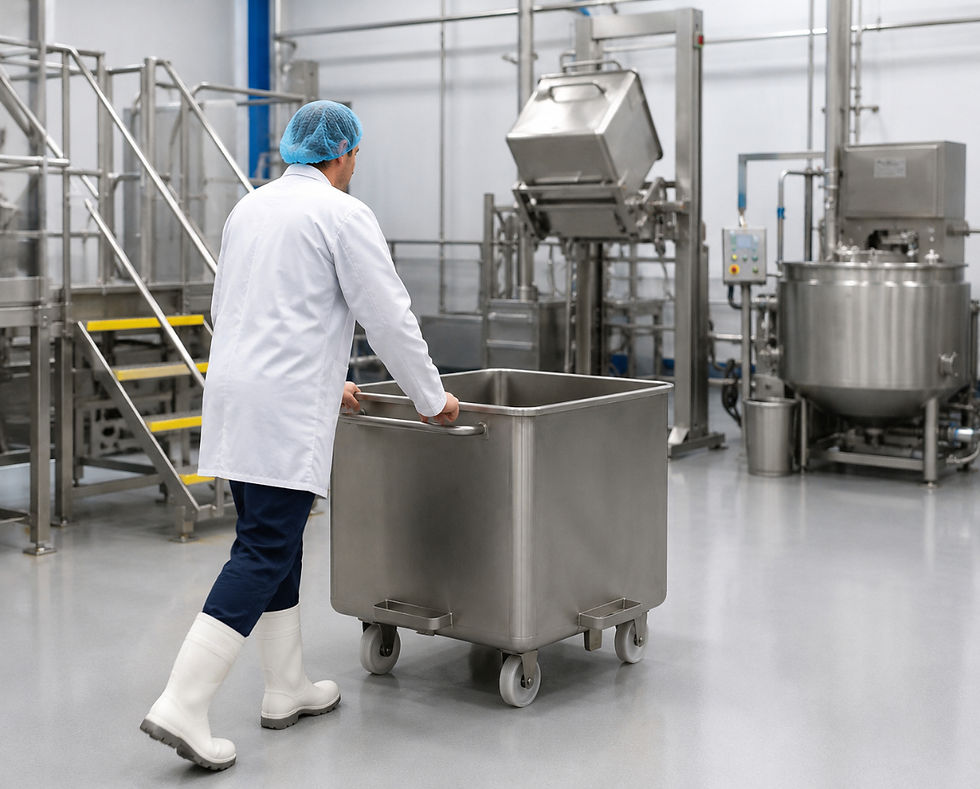
Consider the movement of prepared ingredients into a processing vessel. Ingredients may need to be loaded into a tote bin, moved across the production area, positioned correctly and then discharged.
Individually, each stage may take only a few minutes. Repeated throughout the day, however, inefficient movements can represent a significant amount of lost production time.
When reviewing efficiency, useful questions include:
How many times is the product handled?
How far does it travel between processes?
Are operators waiting for equipment to become available?
Are bins or containers easy to manoeuvre and position?
Does product need to be manually lifted or transferred?
Are there recurring spillages or cleaning interruptions?
Could individual handling stages be removed or simplified?
The objective is not necessarily to make operators move faster. It is to engineer unnecessary movements and delays out of the process.
Designing Mechanical Handling Around Production Flow
Effective mechanical handling starts with understanding how materials need to move through the factory.
Product characteristics, batch weight, travel distance, floor space, discharge height, operator access and the surrounding machinery can all affect the most appropriate handling method.
A tote bin, for example, should not be selected purely according to its capacity. Engineers should consider the weight and consistency of the product, how frequently the bin will move, the route it will take and how its contents will ultimately be discharged.
The same principle applies to lifting and tipping equipment. Tipping height and lifting capacity are important, but so are positioning, operator access, guarding, cleaning access and integration with the receiving equipment.
Looking at the complete journey can reveal inefficiencies that may not be apparent when each piece of equipment is considered separately.
Controlled Transfers Can Improve Efficiency
Product transfer is a relatively small part of many production processes, but it is often repeated hundreds of times.
Where heavy containers need to be emptied into processing equipment, hoppers or other machinery, mechanical lifting and tipping can provide a controlled and repeatable transfer while reducing reliance on manual handling.
Consistency is important here.
If a bin can be positioned and discharged in the same way for every batch, the transfer becomes a predictable part of the process rather than a variable one.
Depending on the factory layout, handling equipment may be fixed at a particular production point or mobile so that it can serve different areas. The correct approach depends on product flow, frequency of use and the flexibility required from the production area.
Hygiene and Efficiency Are Closely Connected
Improving material flow cannot be considered separately from hygiene.
Every additional transfer introduces another point at which product can be spilled or come into unnecessary contact with equipment or the surrounding environment. Poorly positioned handling equipment can also create difficult-to-access areas that take longer to clean.
Reducing unnecessary handling can therefore support both production efficiency and hygiene.
Equipment should also be designed so that surfaces and surrounding areas can be accessed for cleaning and inspection. Stainless steel construction is commonly used within food production environments, but hygienic performance depends on more than material selection alone. Fabrication, accessibility, positioning and the way equipment interacts with the wider factory environment are equally important.
Finding the Lost Minutes in Production
When production teams are under pressure to increase output, the obvious response can be to focus on making the primary process faster.
But increasing the speed of one machine will have limited benefit if operators or products are then waiting at the next stage.
Looking at the entire production flow can identify smaller opportunities for improvement: reducing a transfer, shortening a travel distance, improving the positioning of a bin, mechanising a repetitive lift or creating a more direct route between two processes.
A few minutes saved on an individual movement may appear insignificant. Multiplied across every batch, shift and production day, those minutes can become valuable production time.
Taking a Process-Led Approach
There is rarely a single mechanical handling solution suitable for every food factory.
Existing machinery, hygiene zones, available space, production volumes and future requirements all influence how equipment should be configured. For this reason, the most effective starting point is often the process itself: what needs to move, where does it need to go and what is preventing that movement from being as simple as possible?
Gilwood designs and manufactures mechanical handling equipment for food production environments, including stainless steel tote bins, lift & tip systems, conveyors, trolleys, bogies and dollies, as well as bespoke equipment for applications where a standard configuration does not suit the process.
With more than 60 years of engineering and manufacturing experience, the Gilwood team can work with food factory engineers to assess a handling requirement and develop equipment around the practical needs of the production environment.
Review Your Material Handling Process
If unnecessary movements, manual handling or inefficient transfers are affecting production flow, speak to Gilwood about your application or explore our mechanical handling range.


Comments