


The Role of Conveyors in Food Manufacturing: Improving Efficiency and Reducing Downtime
Conveyor Systems play a critical role in modern food production environments, helping manufacturers maintain product flow, improve efficiency and reduce costly downtime.
From Food Factory Conveyors used in primary processing areas to specialised handling equipment in packaging and dispatch zones, conveyors are essential for creating streamlined, hygienic and productive operations.
Conveyor Systems: The Backbone of Food Production
Efficient Conveyor Systems allow food manufacturers to move products safely and consistently throughout the production process. By automating material handling, businesses can reduce manual intervention, minimise handling risks and maintain continuous production flow.
Having worked with food manufacturers across meat processing, bakery, dairy and ready-meal production facilities, we regularly see conveyor systems become one of the most influential factors in overall line efficiency. Poorly designed conveyor layouts can create bottlenecks, increase cleaning times and lead to unnecessary manual handling, while well-engineered systems support continuous product flow and reduce production interruptions.
In food manufacturing environments, conveyors must be designed to withstand rigorous cleaning procedures while meeting strict hygiene standards. Stainless steel construction, hygienic welds and easy-to-clean designs help prevent contamination and support compliance with food safety regulations.
Modern conveyor systems can be integrated with inspection equipment, weighing systems, packaging machinery and automation controls, creating a seamless production line that maximises output and reduces bottlenecks.
Belt Conveyors for Reliable Product Handling
Belt Conveyors are among the most widely used conveyor solutions in food manufacturing due to their versatility and ability to handle a wide range of products.
Whether transporting raw ingredients, packaged goods, or finished products, belt conveyors provide smooth and controlled movement throughout the production process. Their flexibility makes them suitable for horizontal transport, incline applications and complex production layouts.
When specifying belt conveyors for food production, selecting the correct belt material is just as important as the conveyor itself. For example, high-moisture environments often require different belt characteristics than dry processing areas. In our experience, choosing the wrong belt can lead to premature wear, tracking issues and increased maintenance costs.

Modular Conveyors for Flexible Production Layouts
As production requirements evolve, manufacturers increasingly rely on Modular Conveyors to provide flexibility and adaptability.
We often work with customers who initially require a conveyor for a single production line but later need to expand capacity. Modular conveyors allow future modifications without replacing the entire system, making them a popular choice for manufacturers planning long-term growth.
For food manufacturers introducing new products or increasing production capacity, modular conveyors offer a practical solution that supports future growth. Their robust construction and easy maintenance also help minimise downtime by enabling damaged sections to be replaced quickly without changing the entire conveyor belt.

Roller Conveyors for Packaging and Distribution Areas
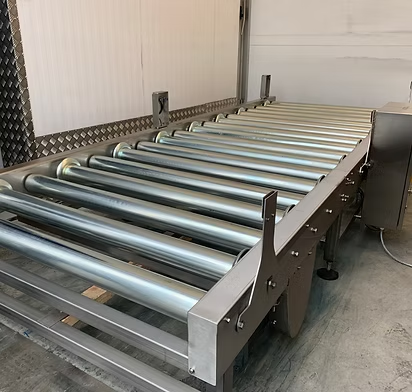
Roller Conveyors are commonly used in secondary processing, packaging, and dispatch operations where products need to be moved efficiently between workstations.
These conveyors are particularly effective for transporting trays, boxes, crates and packaged goods. Depending on operational requirements, roller conveyors can be gravity-fed or powered, providing flexibility for different handling applications.
By reducing manual handling and improving workflow efficiency, roller conveyors help manufacturers optimise labour resources while maintaining smooth product movement throughout the facility.
Spiral Conveyors for Maximising Factory Space
Floor space is often at a premium within food manufacturing facilities. Spiral Conveyors provide an effective solution by allowing products to move vertically while maintaining a compact footprint.
These systems are commonly used for elevation changes between production levels, cooling processes, accumulation zones, and packaging operations.
One of the most common challenges we encounter during factory surveys is limited floor space. In many cases, a spiral conveyor can achieve the required product elevation while occupying significantly less floor area than a traditional incline conveyor, allowing manufacturers to increase throughput without extending their production footprint.
The continuous movement provided by spiral conveyors also reduces congestion within production areas, helping maintain consistent throughput and reducing the risk of production delays.

Rotary Turntables for Smooth Product Transfer
Efficient product transfer between conveyor lines is essential for maintaining production flow. Rotary Turntables are designed to redirect products smoothly and accurately between different processing stages.
Often used in packaging and distribution environments, rotary turntables help prevent product build-up and eliminate bottlenecks that can lead to costly downtime. They also improve operational flexibility by allowing products to be diverted, accumulated, or reoriented as required.
When integrated with automated production systems, rotary turntables contribute to improved line efficiency and enhanced process control.
Food Factory Conveyors and Downtime Reduction
From discussions with production managers and engineering teams, unplanned downtime is often one of the largest hidden costs within a food manufacturing facility. A conveyor failure can quickly affect multiple downstream processes, resulting in lost production time, wasted product and increased labour costs.
In our experience, many conveyor issues can be traced back to poor accessibility for cleaning and maintenance. Designing systems with removable components, accessible drive units and hygienic construction can significantly reduce service times and improve overall equipment availability.
Well-designed Food Factory Conveyors help reduce downtime through:
Hygienic designs that support faster cleaning and sanitation procedures
Durable stainless steel construction for long-term reliability
Easy-access maintenance points for quicker servicing
Modular components that allow rapid replacement of worn parts
Automated product handling that reduces manual intervention
By investing in reliable conveyor solutions, manufacturers can improve production uptime, increase throughput, and reduce operational costs.
Integrated Conveyor Solutions for Future Growth
As food production continues to become more automated, conveyor systems are increasingly being integrated with robotics, inspection technology and smart manufacturing systems.
Advanced conveyor solutions provide real-time monitoring, predictive maintenance capabilities, and improved production visibility. These features enable manufacturers to identify potential issues before they cause downtime, helping maintain continuous production and support long-term operational efficiency.
Designing Conveyor Systems for Hygienic Manufacturing and Processing Equipment
As manufacturers of Hygienic Manufacturing and Processing Equipment, we understand that conveyor performance is only one part of the equation. Hygiene remains equally important.
When designing food factory conveyors, factors such as open-frame construction, drainage, cleanability and material selection must be considered from the outset. Features that simplify cleaning can help reduce washdown times and support compliance with food safety standards.
Every production environment presents unique challenges, which is why bespoke conveyor design often delivers greater long-term value than an off-the-shelf solution.
Looking to improve production efficiency and reduce downtime within your facility?
With decades of experience designing and manufacturing hygienic conveyor solutions for food production environments, Gilwood works closely with customers to develop conveyor systems that improve efficiency, maximise hygiene standards and support future growth.
Contact our engineering team today to discuss your requirements and discover how a bespoke conveyor solution can optimise your production process.

Comments